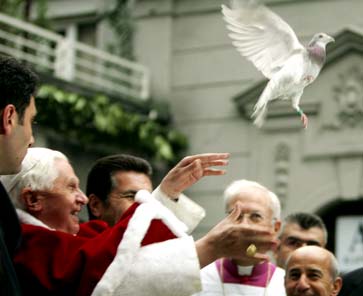
 Although it now seems gradually to arrive in the public awareness of what was already clear from the beginning, Pope Benedict XVI. but first needed to confirm once again, namely that his trip to Turkey, "not a political but a pastoral trip" Now, the discussion about the so-called "Regensburg Lecture" and the relationship between faith and reason will not be shelved. Especially in the media we see has not been in this journey not perceive as an immediate response and continuation of this conflict. It is just done so as if the discussion of this relationship, a new, first with the, now talked to death "Clash of Civilizations" appeared. But this is not the case. Not only since the Enlightenment, and certainly not since John Paul II's encyclical Fides et Ratio "and certainly long before the" Regensburg Lecture "Faith and reason form a thematic unity. Now, if "discovered" is that Christianity is a "religion of reason" when is now found that even for the scholar Joseph Ratzinger faith and reason "from within" belong together, it is said, that this unity has always been for direct self-understanding of Christianity is that they of Theo-logy with Christ, the Logos, necessarily inherent in and the foundation is.
 And this issue of faith and reason has nothing to always deeply related to the peace between the religions, Cusa shows us Nicolaus (1401-1464), was reminiscent of the at this point. The Cardinal, lawyer, politician, astronomer, philosopher, theologian - in short, the universal scholar and saint of the 15th Century, wrote in 1453 in the wake of the fall of Constantinople in his remarkable and highly topical paper "On the peace or the consensus among the religions," concluded the following: "Thus, for now the sky reason decided the harmony of religions." Cusanus designed here a fictional dialogue between Religions dispute in which representatives from different nations and religions and see the people of God were sent to each their own teachers and prophets and that we see all religions, "all the difference more than the rite in the worship of one God is located. (It should be noted that Nicholas also wrote a "critique of Alchoran" [ie Qur'an]). May well be accused of Cusanus here heresy which was done also fails, yet, that he was in the depths of his thoughts on the best scholastics of the Middle Ages Combi desk, they do in terms of modern philosophy still exceeds (and thus clearing the way for Kant's critique of reason prepares).
The reason is to even her own students be. The reason is opposed to a merely intellectual reflection structure of the empirical understanding of knowledge. This difference between understanding and reason, between empirical rationality and reflected speculation can be found at the stage they created Cusanus as a dialectic, namely, when the the higher levels of the mind from the respective lower level shows. Cusanus here formulates a "critique of pure reason", which is a "critique of pure sensuality. Then it is also clear that the truth claims changed in the act of intellectual descent and ascent, as well as the issues remain via reflexionis not the same. That is at the level of "sensations" are No differences before, everything seems was the same because here no question of the truth is. At the level of understanding can be reached via negation, however, either true or false judgments and thus also to a rational concept of truth (in the form of logical correctness). The question of the truth model is only revealed at the level of reason. At this stage of reflection, the rationally constructed distinction of true and false is invalid. The highest level is then for the mind inaccessible visio dei, since this question was not the truth. This "precise truth remains undetectable. There remain understanding and reason, the one in empirical science, the other in the philosophy of the visio dei excited to the transcendent. Reason finally arrives at a notion of truth, false if appropriate judgments. The thinking is in itself a contradictory for Cusanus Done By dar. taught, it leads to ignorance, but ignorance of the taught docta ignorantia - the science of ignorance. It is clear that "the precise truth shines in the darkness of our ignorance in incredible ways and that is the science of ignorance by [...], we only the largest, triune God of infinite goodness on the steps of this science are close able to praise him with all his might for ever that he himself us to recognize them as incomprehensible. "In this sense it is any rational human knowledge of God possible, but are actually tangible. Here, the agreement is in the religions and here lies the peace, already Nikoluas Cusa recognized over 500 years ago. To date, he has lost none of its topicality
. (quoted in Nicholas of Cusa: Philosophical and theological writings, 2005)


0 comments:
Post a Comment